Your Surveillance Network Is Only as Strong as Its Weakest Signal
How TEAL’s Network Orchestration Service and Multi-Carrier Unlimited 5G Eliminate the Connectivity Risks That No Camera Upgrade Can Fix
Security professionals spend billions each year on smarter cameras, better analytics, and tighter integrations with operations platforms. But there’s a vulnerability hiding in plain sight: one that no firmware update or hardware upgrade can fix.
Connectivity.
When a camera drops its cellular link mid-incident, the analytics don’t matter. When a carrier has a regional outage and dozens of cameras go dark at once, the edge AI sitting on those devices is completely irrelevant. And when a deployment grows across regions but each site is locked to a different carrier contract, the operational overhead quietly drains resources that should be going toward security, not SIM logistics.
This is the connectivity gap. And it’s more widespread, and more consequential, than most organizations acknowledge.
The Real Problem Isn’t Hardware. It’s How Hardware Connects.
Modern IP-based cameras are remarkable pieces of technology. High-definition video, onboard analytics, edge processing, seamless cloud integration: the hardware story has largely been told. But there’s an underlying assumption baked into most surveillance deployments that rarely gets examined: that the network will simply be there.
It won’t always be. And the consequences of that assumption are felt exactly when it matters most.
Single-Carrier Dependence Creates a Single Point of Failure
Traditional surveillance infrastructure is built around single-carrier cellular connections. The logic seems sound: pick a major carrier, deploy your SIMs, move on. But that architecture means your entire network inherits one carrier’s coverage footprint, one carrier’s outage risk, and one carrier’s limitations.
Carriers go down. Coverage varies dramatically across geographies. A tower goes offline during a storm. A regional network event takes out a portion of the infrastructure. In each case, every camera tied to that single carrier goes dark simultaneously: right when your security team needs visibility most.
Metered Data Plans Punish High-Performance Deployments
Modern surveillance cameras aren’t light data consumers. A continuous 4K feed doesn’t fit neatly into a metered plan designed for an era when devices sent occasional sensor pings. As video quality has improved and analytics have grown more sophisticated, the data demands of a properly functioning surveillance network have increased dramatically.
Metered plans create a perverse dynamic: the better your cameras work, the higher your costs climb. Operations teams end up throttling video quality, limiting analytics, or accepting surprise overages, all to manage a cost structure that was never designed for high-tonnage IoT operations.
Carrier Lock-In Destroys Operational Flexibility
Ask any enterprise IT team what it takes to migrate a fleet of surveillance cameras to a new carrier and you’ll see the problem clearly. Physical SIM swaps across potentially hundreds or thousands of devices. New vendor negotiations. Provisioning delays that can stretch weeks. And through all of it, the cameras stay on the old network, or they go offline.
When a better coverage option becomes available, when costs shift, or when a new deployment site requires a different network, organizations trapped in rigid carrier relationships simply can’t respond. The result is surveillance infrastructure that’s perpetually behind the curve.
TEAL’s Answer: Network Orchestration Service (NOS)
TEAL built its Network Orchestration Service specifically to dismantle these constraints. NOS is the intelligent connectivity layer between your surveillance hardware and the world’s cellular networks: designed from the ground up for the demands of mission-critical, always-on IoT deployments.
Multi-Carrier Redundancy with Automatic Failover
NOS eliminates single-carrier risk by providing built-in access to multiple carriers simultaneously. When a primary carrier experiences degradation or an outage, NOS detects the issue and switches to the next best available network: automatically, in seconds, without operator intervention.
For a smart city operator running license plate recognition across a metro area, this means a regional carrier event doesn’t create coverage blind spots. For a critical infrastructure operator protecting a government facility, it means the network never stops working, even when individual carriers do.
Automatic failover isn’t a feature to evaluate against competitors. For mission-critical surveillance, it’s the baseline requirement that single-carrier deployments fundamentally can’t meet.
BYOC and BYOS Flexibility: Zero Lock-In
TEAL’s Bring Your Own Carrier (BYOC) and Bring Your Own SIM (BYOS) capabilities give organizations complete freedom over which networks power their devices. Switch carriers remotely without physical SIM swaps. Leverage existing carrier relationships where they make sense. Choose the best available network for each deployment location.
The power to decide never leaves your hands, and the process of switching never requires a technician in the field.
Global Coverage Across 195+ Countries
Surveillance operations don’t stop at national borders. Government agencies protecting international assets, logistics operators monitoring cross-border corridors, and enterprises managing multi-region deployments all face the same challenge: piecing together regional carrier agreements that leave coverage gaps and create management complexity.
NOS provides native access to best-in-class networks across 190+ countries through a single platform and a single vendor relationship. One contract. Global reach. No coverage blind spots.
Real-Time Visibility Through the Aurora Dashboard
Connectivity problems that go undetected become security failures. TEAL’s Aurora Dashboard provides operations teams with complete real-time visibility into every device’s connection status, data consumption, and network performance, all the time.
Proactive alerting means issues are identified and addressed before they become outages. Instead of learning about a camera going offline through a security incident report, your team knows the moment a connection degrades and can respond accordingly.
Pay for What You Use: Not What You Don’t
NOS replaces traditional carrier economics with a consumption-based model. You pay for the data your devices actually use, with no minimum obligations baked in. For surveillance deployments where bandwidth demands fluctuate: lighter overnight, heavier during events or incidents: this can translate into substantial cost efficiency at scale.
When High-Data Operations Demand More: Multi-Carrier Unlimited 5G
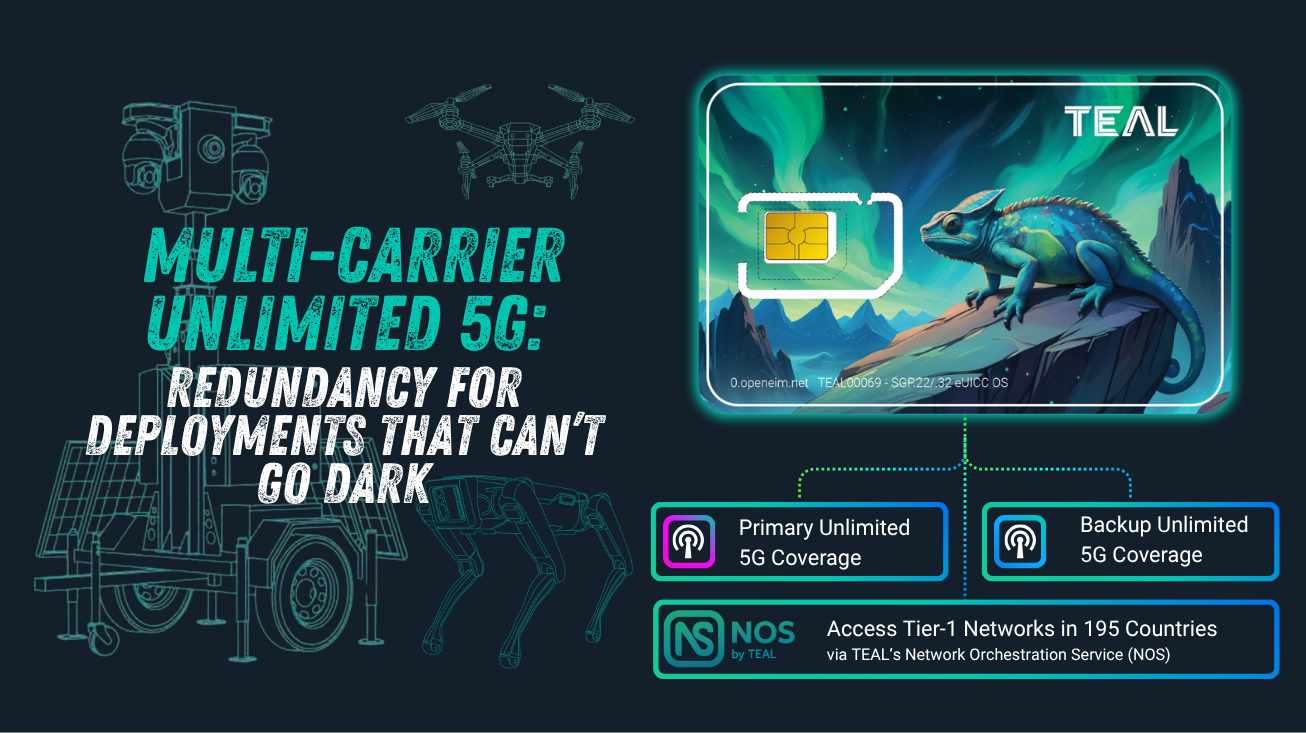
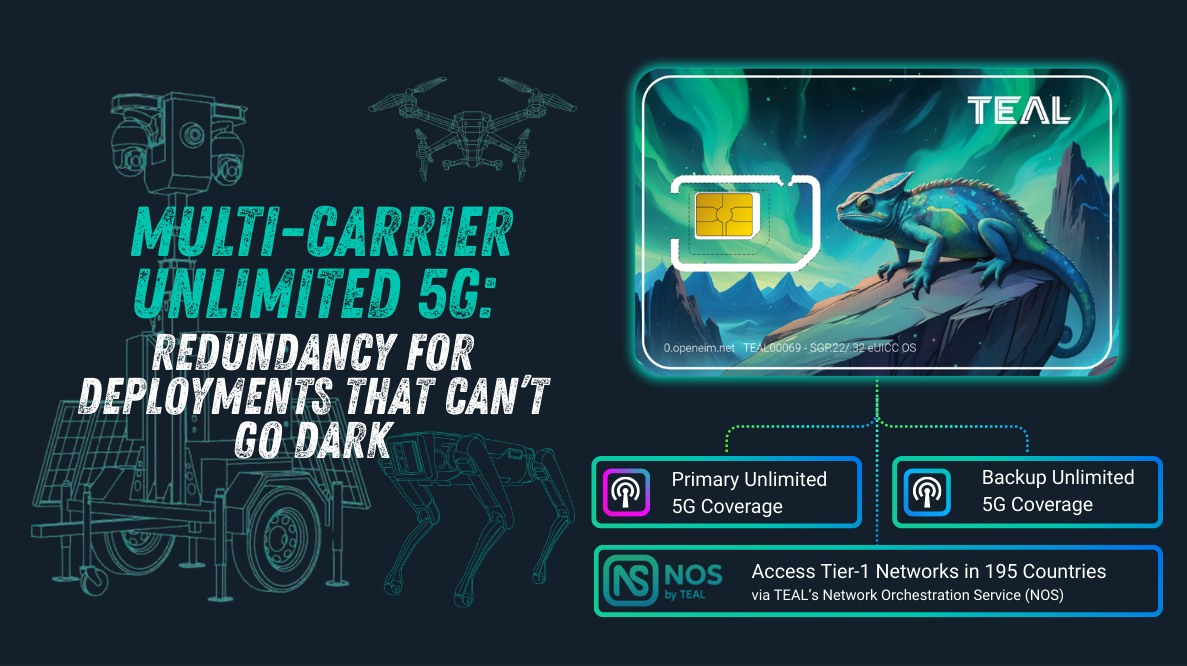
For organizations running the highest-intensity surveillance and IoT deployments, including continuous 4K feeds, autonomous security robots, drone operations, or multi-system gateways, pay-as-you-go may not be the right model. The volume and consistency of data transmission is simply too high, and predictable costs matter as much as predictable connectivity.
That’s where TEAL’s Multi-Carrier Unlimited 5G Plans come in.
Unlimited Data, Multiple Carriers, One Price
At $99 per device per month, TEAL’s Multi-Carrier Unlimited 5G plans deliver access to multiple U.S. Tier-1 carriers on a single eSIM, with no data caps, no throttling, and no per-megabyte surprises. Your 4K surveillance feeds, your autonomous equipment telemetry, your real-time facility monitoring: all of it runs without ceiling.
This isn’t a marketing claim about “unlimited” that quietly cuts speeds after a threshold. TEAL’s unlimited plans are purpose-built for high-tonnage consumption, designed around the real-world demands of devices that transmit continuously.
True Tier-1 Carrier Access: Not Roaming
Most MVNO solutions and so-called multi-carrier offerings are built on roaming agreements: a secondary status that comes with lower priority, reduced performance, and carrier-level vulnerability to policy changes. TEAL’s patented, GSMA-certified eSIM technology holds direct agreements with more network operators than any other connectivity provider, providing genuinely native access to Tier-1 carrier networks.
The result is connectivity that performs like a first-party carrier relationship, with the flexibility of a multi-carrier platform and the resilience of automatic failover built in.
“This offering is well suited for mission-critical IoT connectivity, especially for industries that rely heavily on constant, high-volume data transmission.” Michael Johnston, Chief Business Officer, TEAL
Fully Programmable, Pre-Paid Simplicity
TEAL’s platform puts operations teams in complete control. Remote carrier switching. Device management at scale. Provisioning without field technician deployments. And a fixed monthly fee that makes budgeting straightforward and scaling predictable: no long-term contracts, no surprise invoices.
Who This Is Built For
TEAL’s NOS and Multi-Carrier Unlimited 5G plans aren’t general-purpose connectivity products. They were built for deployments where failure carries real consequences:
- Video Surveillance: Security cameras generating continuous high-definition streams need guaranteed uptime. Multi-carrier redundancy closes the coverage gaps that single-carrier solutions leave open.
- Smart Cities and Critical Infrastructure: License plate recognition, traffic monitoring, public safety cameras, and environmental sensors across metro areas need the kind of resilience that city operations demand.
- Robotics and Autonomous Security Systems: Factory robots, warehouse automation, and autonomous security platforms depend on always-on, low-latency connectivity. A dropped connection in these environments isn’t inconvenient: it can be dangerous.
- Drone and BVLOS Operations: Beyond-visual-line-of-sight missions require reliable data links in areas with variable and unpredictable signal strength. Multi-carrier coverage ensures the fleet stays connected regardless of which carrier is having a bad day at a given location.
- Business Continuity and Network Backup: When primary internet connections fail, multi-carrier cellular backup with unlimited data ensures operations continue without throttling exactly when traffic is highest.
- LoRaWAN Gateways and Device Hubs: Gateway devices aggregating data from hundreds of downstream sensors need high-capacity, reliable backhaul. TEAL delivers exactly that.
The Complete TEAL Connectivity Ecosystem
TEAL’s value isn’t just in the connectivity plan: it’s in the complete platform that surrounds it.
The Aurora Connectivity Dashboard and Marketplace serves as the centralized command center for all connected devices, delivering real-time monitoring, usage analytics, and remote carrier management through a single interface.
OpenEIM is TEAL’s open, free SGP.32 eIM (eUICC IoT remote manager), purpose-built to eliminate the interoperability limitations and vendor lock-in of traditional eSIM systems. For organizations evaluating next-generation connectivity infrastructure, it’s a zero-cost entry point.
TEAL eSIM Cards are the GSMA-certified hardware that brings NOS and Multi-Carrier Unlimited 5G to life at the device level, supporting both SGP.02 and SGP.32 standards and compatible with today’s leading surveillance and IoT hardware.
Together, this stack delivers surveillance-ready connectivity that scales from a single pilot camera to thousands of devices deployed globally, without adding carrier negotiation complexity or SIM logistics overhead.
What Staying Connected Actually Looks Like
Consider a retail loss prevention operation expanding surveillance to seasonal locations on short notice. With traditional connectivity, that means SIM procurement delays, carrier provisioning timelines, and days or weeks without coverage at new sites. With TEAL NOS, activating connectivity at a new location is a remote, software-driven operation: coverage on demand, the day the cameras go up.
Or consider a government agency running perimeter surveillance at a critical facility. A major carrier in the region experiences a two-hour outage. With a single-carrier deployment, that’s two hours of surveillance blind spots. With TEAL NOS, affected cameras switch to the next best available network in seconds: the control room never loses visibility.
These scenarios aren’t hypothetical edge cases. They’re the exact operational realities that TEAL’s platform was engineered to address.
The Connectivity Layer Has Fallen Behind. NOS Closes the Gap.
The surveillance industry has invested heavily in the intelligence layer: smarter cameras, better analytics, tighter integration with security operations centers. But the connectivity layer has been left behind, still dependent on single-carrier relationships, fragile SIM logistics, and infrastructure that treats the network as an afterthought.
TEAL’s Network Orchestration Service: and the Multi-Carrier Unlimited 5G plans built on top of it: bring that same level of intelligence, flexibility, and resilience to connectivity that the rest of the surveillance stack already demands.
Multi-carrier redundancy. Automatic failover. Global coverage. Zero lock-in. Real-time management. Unlimited data for deployments that need it. Pre-paid simplicity for deployments that don’t.
Your cameras are too important to leave their connectivity to chance.
Ready to eliminate the connectivity gap from your surveillance network?
Start free with TEAL’s OpenEIM at tealcom.io/openeim or schedule a conversation with the TEAL team at tealcom.io/schedule-meeting to see how NOS and Multi-Carrier Unlimited 5G can transform your mission-critical connectivity.

If you are deploying surveillance cameras, access control systems, or any security-focused IoT infrastructure, we want to talk. TEAL will be attending ISC West 2026 in Las Vegas, the premier event for the physical security industry.
Stop by Booth 7039 to see how multi-carrier unlimited 5G can eliminate connectivity blind spots in your security deployments. Our team will be on hand to walk through live demos and discuss how TEAL fits your specific use case.
Schedule a meeting with the TEAL team at ISC West:
Book a Meeting!