Why IoT Device Makers Are Still Trapped (And How Network Orchestration Finally Sets Them Free)
If you’ve been deploying IoT devices at scale, you’ve probably run into the wall.
You chose a carrier, negotiated a contract, and built your supply chain around it. Then the cracks started to show. Coverage gaps appeared. New markets exposed the limits of your operator. And adding even one more carrier means months of negotiations, new SKUs, parallel supply chains, and duplicated overhead.
This is carrier lock-in. It’s been the dirty secret of the IoT industry for years.
eSIM Was Supposed to Fix This. It Didn’t.
The promise of eSIM was simple: one chip, any network, total flexibility. The reality has been far more complicated.
Most eSIM offerings come from the very carriers and MVNOs that have a commercial interest in keeping you on their network. As TEAL CEO Robby Hamblet puts it: “An eSIM is provided by an MVNO to tick a box and, yes, technically it is an eSIM. It just doesn’t have any of the orchestration or flexibility that you would expect.”
MNOs and MVNOs are structurally conflicted. Helping a customer switch networks runs counter to their own commercial interests. The result: a decade of eSIM failing to lower the barrier to entry for IoT organisations seeking genuine connectivity flexibility.
What Actually Needs to Change
The real problem isn’t your SIM. It’s the layer above it.
When your carrier goes down, your operations stop. When you need to expand to a new market, you’re rebuilding from scratch. When you want leverage in a vendor relationship, you have none. These aren’t edge cases. They’re the everyday reality of deploying connected devices at scale.
What’s missing is a neutral orchestration layer that sits above all carriers and puts device makers in control.
Enter Network Orchestration
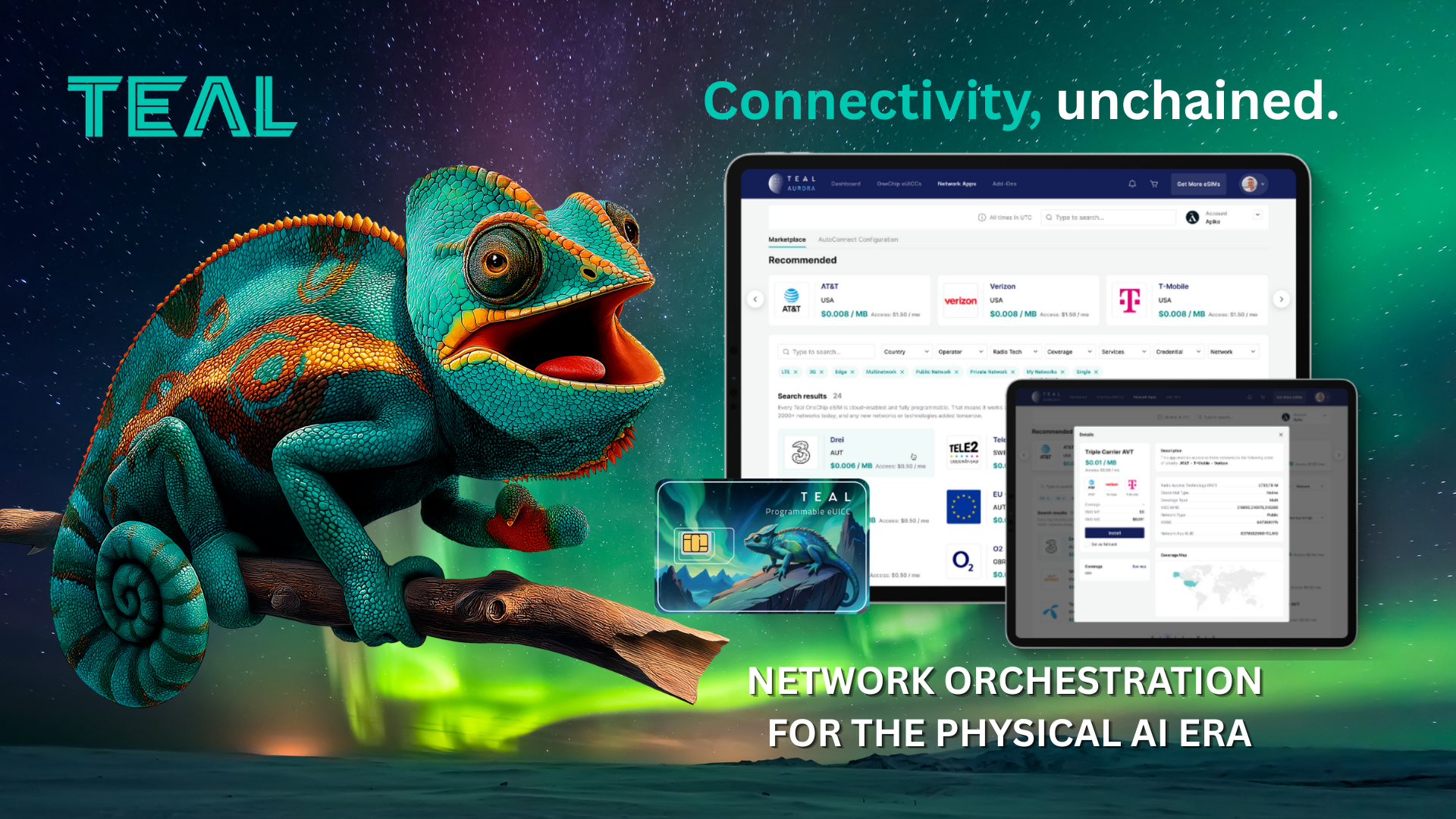
TEAL’s Network Orchestration Service (NOS) was built to solve exactly this. Rather than replacing your carrier relationships, it orchestrates them, giving you the freedom to manage, switch, and scale connectivity without the friction.
“You can pick up options as you need them and onboard the things you need, when you need them,” says Hamblet. “You’re not restricted in any way with TEAL from using any operator in the world.”
Here’s what that looks like in practice:
- No more dark zones. Automatic failover to backup carriers in seconds means a single network outage doesn’t take down your operations.
- Coverage in 190+ countries. Access the best core network in any market through one unified platform, no new contracts required.
- Bring your own carrier (BYOC). Already have AT&T, Verizon, or T-Mobile? Self-onboard your existing relationships at no cost and manage everything from one place.
- No minimum obligations. Pay only for the data you use. eSIM management is free if you bring your own SIM and carrier agreement.
Hamblet describes TEAL’s ambition plainly: “We want to be Switzerland. We think that device makers deserve a neutral provisioning layer and deserve something more fully-baked than traditional eSIM vendors provide.”
Non-Negotiables for eSIM to Actually Work
Hamblet is direct about what it takes for eSIM to finally succeed: “For eSIM to succeed, it has to break free from traditional models and for us to finally digitise this, it has got to be free, it has got to be neutral and it has got to be easy to use.”
Most solutions on the market fail at least one of those. TEAL is built to deliver all three simultaneously.
Carrier integrations that previously required up to 10 months of bilateral negotiation now happen in minutes through TEAL’s self-serve portal. That’s not a small improvement. That’s a fundamental shift in how connectivity gets deployed.
Built on the Next Generation Standard
The GSMA’s SGP.32 specification, the most significant evolution of the IoT eSIM standard, has now been ratified. TEAL contributed patented mechanisms to the spec itself, including polling interface technology that eliminates the need for SMS in device management.
Its SGP.32-certified product, Chameleon Edition, is available now. Combined with OpenEIM, TEAL’s free and open eUICC IoT remote manager, it’s the most complete implementation of the new standard available to device makers today.
Real Deployments. Real Results.
TEAL is already powering connectivity for some of the most demanding IoT deployments in the world, including autonomous delivery robots, drone fleets, and global navigation systems.
As one customer put it, TEAL gives teams “on demand access and real time configuration on any supported mobile network worldwide, which translates into easy, fast, and reliable deployment… anywhere in the world.”
The Question Has Changed
For IoT device makers, the question used to be whether genuine connectivity flexibility was even possible. That question has been answered.
The question now is simpler: how much longer can you afford to operate without it?